
Pushing Boundaries in Pediatric Surgery: Launching One of the Nation’s First Pediatric Robotic Thoracic Programs


In 2023, Children’s Wisconsin began a transformative initiative in partnership with Froedtert Hospital to launch one of the nation’s first dedicated pediatric robotic thoracic surgery programs. This innovative effort reflects our commitment to improving outcomes and expanding care options for children with complex thoracic conditions.
Robotic surgery has redefined adult thoracic care over the last two decades, offering greater precision, smaller incisions, less postoperative pain and faster recovery.¹ Robotic technology has allowed for a minimally invasive approach even in more complex procedures such as esophagectomy or sleeve lobectomy. Extending this technology to pediatrics, however, presents challenges due to smaller anatomy, limited case volumes and the need for tailored surgical tools and training. While robotics has become common in pediatric abdominal procedures, its role in thoracic cases remains limited.²
Recognizing the opportunity to advance care, pediatric and adult thoracic surgeons at Children’s Wisconsin and Froedtert joined forces to integrate robotic technology into pediatric thoracic surgery. Rather than build independently, the pediatric team leveraged the deep experience of adult colleagues to establish protocols and best practices. Pediatric surgeons engaged in observation and hands-on dual-console training at Froedtert to build proficiency in robotic techniques.³
We were focused on creating a high-performing multidisciplinary robotics team. To do so, pediatric surgeons received simulation-based training, while anesthesiologists, nurses and surgical assistants collaborated in structured practice sessions to standardize patient positioning, docking, port placement and instrumentation. We emphasized consistent protocols and strong team-wide communication to streamline care delivery.
Our team deliberately chose straightforward operations as the first robotic procedures performed at Children’s Wisconsin. We began with thoracoscopic procedures commonly performed in adolescents, such as peripheral lung wedge resections and apical chest wall tumor excisions. As our confidence grew, we introduced more complex operations such as lobectomies.³ Pediatric surgeons performed initial steps, with adult thoracic surgeons assisting or demonstrating more advanced techniques.⁴

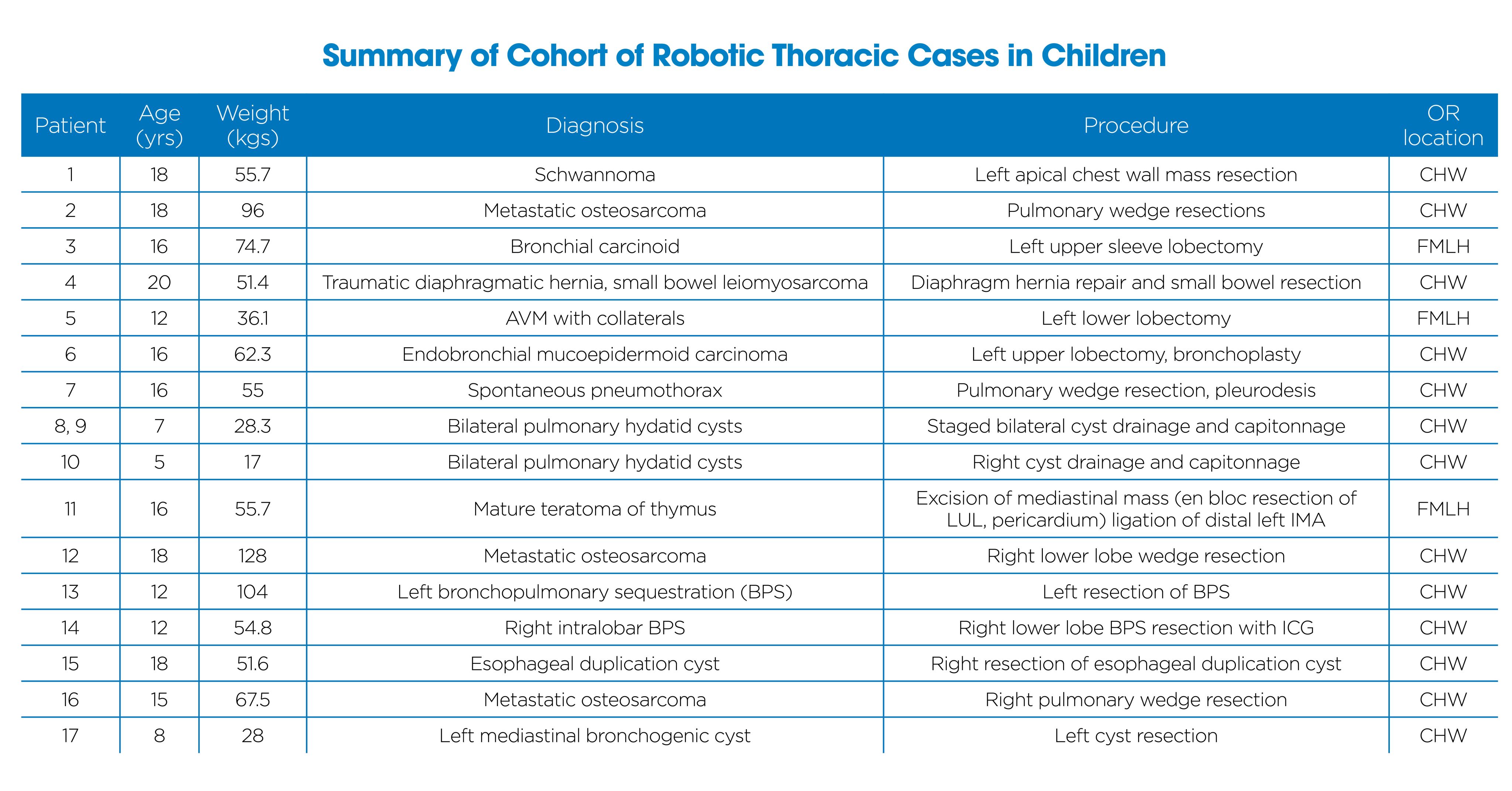
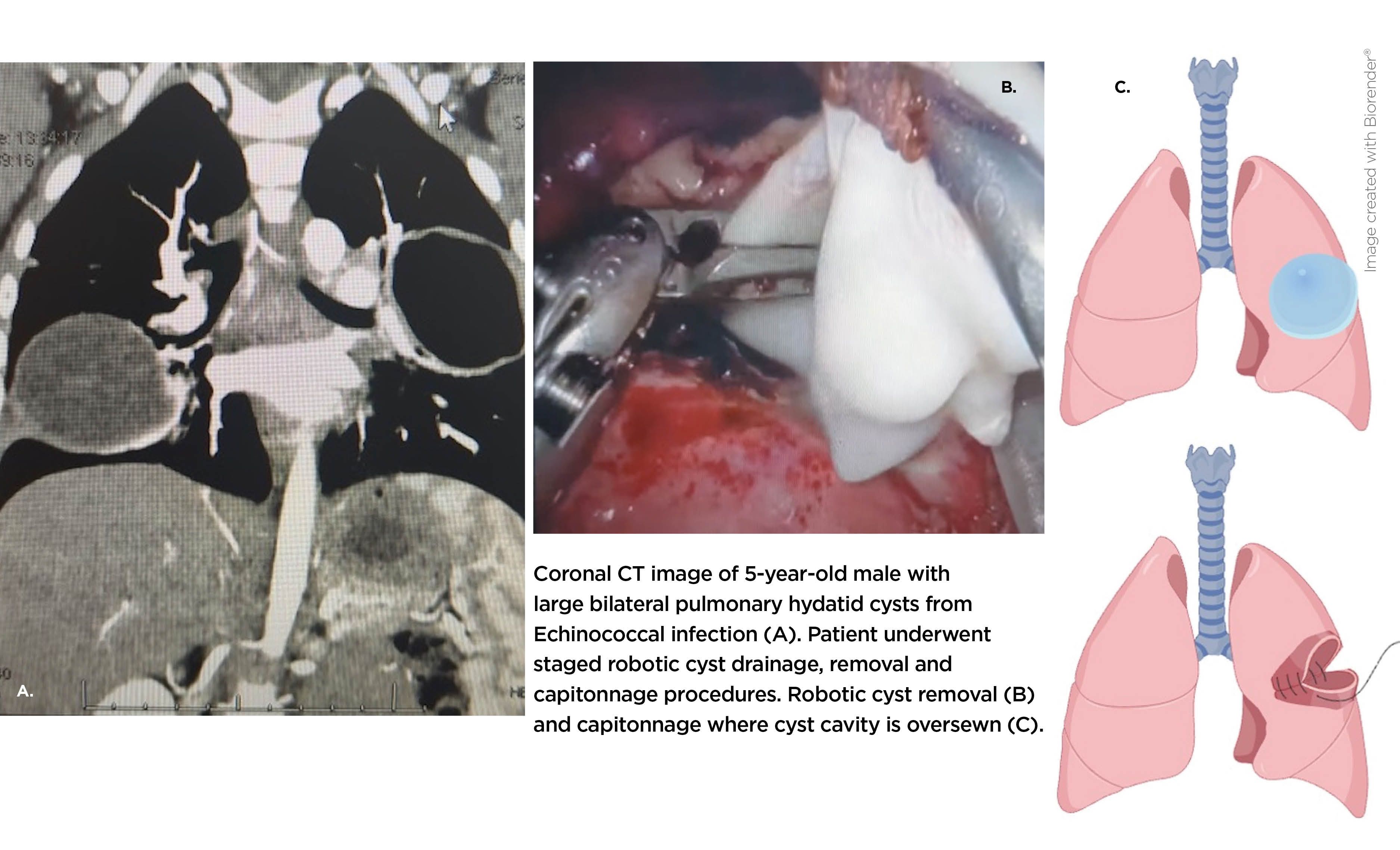
Between April 2024 and July 2025, our team completed 10 collaborative pediatric robotic thoracic surgeries, including eight performed at Children’s Wisconsin. Among them were three lung surgeries for echinococcal hydatid cysts in two children with bilateral disease, representing the youngest reported patients treated robotically for this condition.
For complex, high-risk procedures early in the program, such as a carcinoid tumor requiring sleeve lobectomy or a pulmonary arteriovenous malformation following failed embolization, our team chose to operate at Froedtert, an adult hospital which has an established robotics team. This approach ensured access to optimal resources while maintaining active involvement from the pediatric surgical team. These strategic decisions balanced patient safety with progressive skill-building for long-term program success.
This program marks a significant milestone in pediatric surgery and lays the groundwork for continued growth. As robotic systems evolve and instrumentation becomes better suited to smaller patients, the application of these techniques is expected to expand.
Our team’s objective extends beyond increasing procedure volume. Our goal is to enhance the standard of care for children with complex thoracic conditions by broadening access to minimally invasive, highly precise surgical options.
This collaborative model — merging adult thoracic expertise with pediatric specialization — demonstrates how multidisciplinary partnerships can drive innovation and improve outcomes. Children’s Wisconsin is establishing a new benchmark for excellence in pediatric surgical care.
As one of the first of its kind, this initiative provides a replicable framework for institutions seeking to integrate robotic techniques into pediatric thoracic surgery. It is a testament to careful planning, deep collaboration and a steadfast focus on quality and safety.
These early successes are just the beginning. As the program matures, our team remains committed to advancing pediatric innovation, refining practice and improving lives, one child at a time.



References
1. Oh, Daniel S et al. Robotic-Assisted, Video-Assisted Thoracoscopic and Open Lobectomy: Propensity-Matched Analysis of Recent Premier Data. Ann Thorac Surg, vol. 104, no. 5, 2017.
2. Jacobson, Jillian C, and Samir R Pandya. Pediatric Robotic Surgery: An Overview. Sem Pediatr Surg, vol. 32, no. 1, 2023. Geraci, Travis C et al. Beyond the Learning Curve: A Review of Complex Cases in Robotic Thoracic Surgery. J Thorac Dis, vol. 13, no. 10, 2021.
3. Linsky, Paul L, and Benjamin Wei. Training in Robotic Thoracic Surgery. J Vis Surg. vol. 4, 2018.
 Built with Shorthand