
Closing the Loop: Advancing the “Act” Phase in Cardiac Surgical Quality Improvement

The science of quality improvement in medicine traces back to Avedis Donabedian, who in 1966 introduced a framework for evaluating health care through structure, process and outcomes.¹ Over time, our field has drawn from industrial engineering, particularly innovations from early 20th century manufacturing.
One of the most influential models is the Plan-Do-Study-Act (PDSA) cycle, created by Walter Shewhart and W. Edwards Deming.² ³
The PDSA cycle emphasizes planning, implementing, evaluating and adapting. Yet in cardiac surgery, many improvement efforts stall in the Study phase. We often collect data with great care but fall short of turning those findings into meaningful change. Donald Berwick described this challenge as “quality by inspection,” the false belief that measurement alone leads to progress.⁴
A creative answer to this problem came from colleagues at The Hospital for Sick Children in Toronto. Their “Flight Plan” model applies aviation safety principles⁵ and uses a control chart to map each patient’s journey across the perioperative continuum. This chart highlights milestones, care phases and outcomes, and each case is reviewed in near real time at a weekly multidisciplinary meeting. The process encourages broad participation, invites actionable suggestions and turns reflection into improvement by deliberately activating the Act phase.
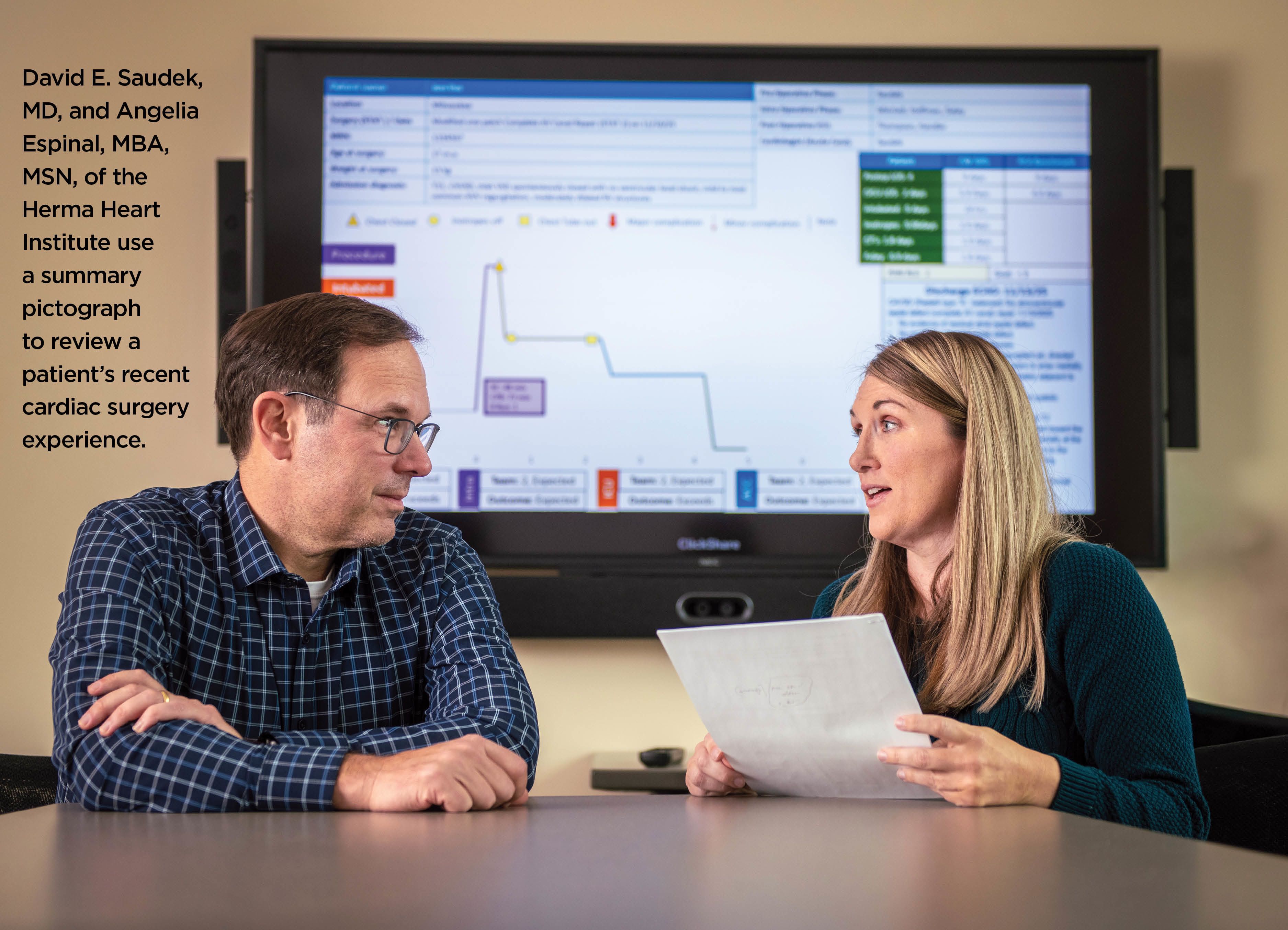
At the Herma Heart Institute, we have built on this approach through our “Clinical Case Review.” Every Tuesday we gather by teleconference to discuss each patient who had surgery the prior week. We use a summary pictograph to walk through the entire course of care, identifying what went well and where we can improve. Our team members share observations, call out breakdowns and suggest solutions. These conversations lead directly to process targets and timely adjustments in practice.
Clinical Case Review has grown into an embedded intervention that brings together voices across disciplines. Participation has steadily increased, and with it, a shared sense of ownership. Alongside other Act initiatives, this model has contributed to measurable improvements in surgical outcomes and has strengthened our culture of collaboration.
By closing the Shewhart-Deming loop, we are not just tracking outcomes, we are building a culture of responsiveness, accountability and continuous learning for every patient we serve.


References
1. Donabedian A. Evaluating the quality of medical care. 1966. Milbank Q. 2005;83(4):691–729.
2. Shewhart WA. The application of statistics as an aid in maintaining quality of a manufactured product. J Am Stat Assoc. 1925;20:546–548.
3. Deming WE. Quality, productivity, and competitive position. Cambridge, MA: MIT Center for Advanced Engineering Study; 1982.
4. Berwick DM. Continuous improvement as an ideal in health care. N Engl J Med. 1989;320(1):53–56.
5. Hickey EJ, Halvorsen F, Laussen PC, Hirst G, Schwartz S, Van Arsdell GS. Chasing the 6-sigma: Drawing lessons from the cockpit culture. J Thorac Cardiovasc Surg. 2018;155(2):690–696.
 Built with Shorthand